 TFTraits
TFT win and loss streaks: gold values, max streak, and how long you can lose
Win streaks and loss streaks pay the same bonus gold, and both crush playing for coin flips. We ran the numbers in the TFTraits Comp Simulator: the exact streak table, what a full streak is worth, and how many rounds you can afford to lose before the game kills you.

Streak gold is the third income stream in TFT, next to base gold and interest, and the only one you control fight by fight. Played on purpose it is worth 50 to 75 extra gold over a game. Played as coin flips it is worth 11.
The streak gold table
The values come from patch 16.15 game data and have been stable for several sets:
| Streak length | Bonus gold per round |
|---|---|
| 2-4 | +1 |
| 5 | +2 |
| 6+ | +3 |
Identical for win and loss streaks. Every PvP win also pays 1 gold on top, streak or not.
Three details the table leaves out. The streak itself has no cap, only the bonus does: the tenth loss in a row still pays +3. The bonus lands with your income at the start of the next round. And PvE rounds (Krugs, Wolves, and the other monster rounds) pay no streak gold but do not break your streak, so it carries straight through them.
Route 1: win streak through stages 2 and 3
Winning early is the best economy in the game. By the 4-2 rolldown a full win streak has paid 35 extra gold (23 from the streak, 12 from win gold), while a mixed record has paid 6. Over a full game to 6-2 the gap grows to 75 versus 11. Here is the full win streak as a simulator plan: open it, and the Rounds tab shows the streak bonus landing every round while health never moves.
The catch is that win streaks are bought with tempo. Holding the strongest board in stage 2 means spending on upgrades and rolls the econ players are skipping, and a streak that breaks at 3-3 means you paid that tempo for nothing. The simulator will not judge your board for you: mark the fights you honestly expect to win, and let the ledger price the rest.
The spike: why loss streaks need an exit
A loss streak is a loan. The gold is real, but you are paying health for it, and health only buys time. The plan only works if it ends in one hard spike: level up, roll the bank down, and flip from losing every round to winning almost every round in a single turn. Miss the spike and you are a low-health player with an average board, which is how eighth places are made.
Route 2: the open fort (lose stages 2-3, spike at 4-1)
The classic loss-streak plan: concede every fight of stages 2 and 3, bank everything, and spike at 4-1. Open the plan in the simulator and the ledger shows what you are buying: 22 extra gold by 4-2, an untouched bank sitting at max interest, and a level lead from all that spare econ. The cost is written in the health column: 100 down to 38 by the end of stage 3. Against a weak lobby you exit closer to 48, against a strong one closer to 28.
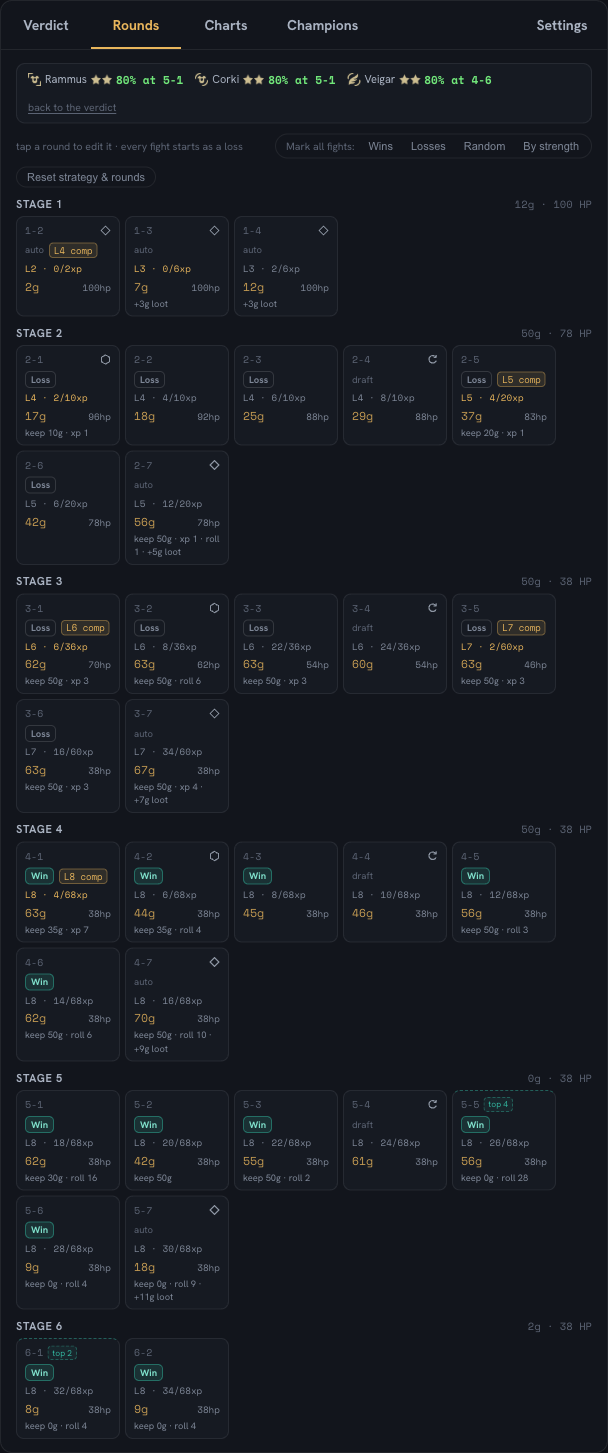
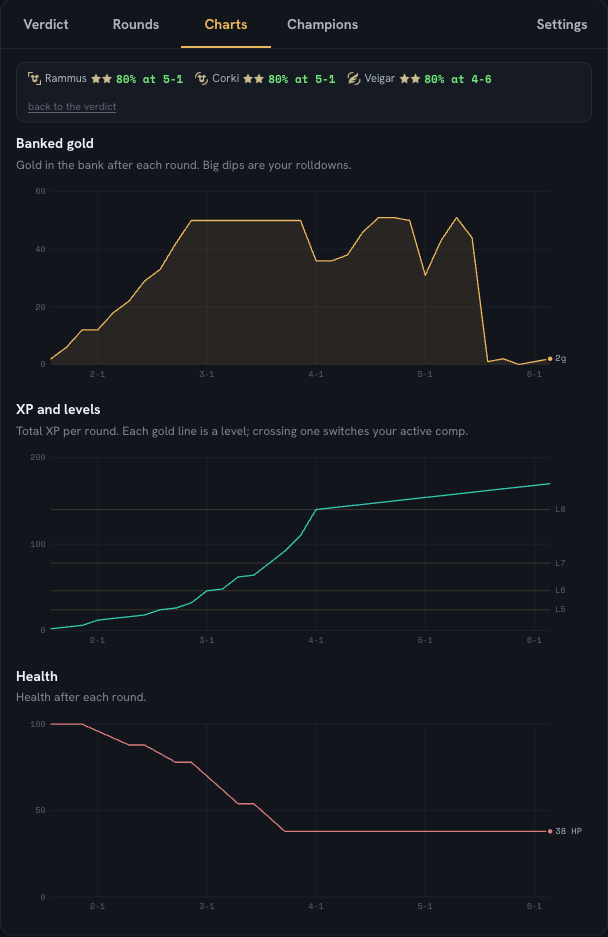
The pros: nearly win-streak money without needing a strong board, a natural fit for Fast 8 spikes, and early carousel picks while your health is low. The cons: the spike has to land on the first try, an accidental early win resets the streak, and from 38 health every future mistake is expensive.
How long can you keep losing?
The clock on every loss streak is elimination, and lobbies thin out on a rough schedule: the bottom players start dying late in stage 4, staying top 4 is usually decided around 5-5, and top 2 around 6-1. Damage rises on the same clock: single digits per loss in stages 2 and 3, then 12 or more from stage 4 on. Losing every round from 2-1 on the expected damage curve, this is your health at each bail-out point:
| Still losing at | Expected health | Weak lobby | Strong lobby |
|---|---|---|---|
| 3-6 | 38 | 48 | 28 |
| 4-2 | 14 | 26 | 2 |
| 4-5 | dead | 4 | dead at 4-3 |
Expected damage = stage base + 1 per surviving enemy unit; weak and strong lobbies are the same model with 2 fewer or 2 more units.
So the practical rule: a loss streak that has not spiked by 4-1 is on borrowed time, and one that reaches 4-5 is dead. Here is the never-spike version in the simulator, eliminated at 4-5 with 53 gold of streak income it never got to spend on anything that mattered.
Route 3: no plan (the coin flip)
Alternating wins and losses pays no streak gold at all. Over a whole game the mixed record earns 11 extra gold to the win streak's 75 and the open fort's 55, and the expected damage curve still kills you around 5-6. The coin-flip ledger is here. It is not a strategy, it is the tax for not committing: if your board cannot streak up, streak down on purpose.
The four plans side by side
| Plan | Extra gold by 4-2 | Extra gold by 6-2 | Health at 4-2 | How it ends |
|---|---|---|---|---|
| Full win streak | 35 | 75 | 100 | top-2 pace |
| Open fort, spike at 4-1 | 22 | 55 | 38 | alive and rich at 38 HP |
| Full loss streak, no spike | 23 | 53 | 14 | dead at 4-5 |
| Coin flip | 6 | 11 | 55 | dead around 5-6 |
Extra gold = streak + win income only; base income and capped interest are identical across the plans, so the difference is pure streak money.
Test your own game
Open the Comp Simulator, build your comp, pick a strategy, and mark the fights you expect to win and lose in the Rounds tab (or press "By strength" and let your comp grades seed them). Every edit re-simulates the whole game: gold, streaks, levels, health, and your odds of hitting the comp before the game ends. All four plans above are live links, so you can start from any of them and bend it toward your own lobby.